So, you’re ready to start your own landscaping business? Good on you. But before you start quoting jobs or buying your first piece of gear, there are a few things you need to nail down. Getting your ABN, insurance, and bank account sorted is the first real step. It’s what separates the pros from the weekend warriors and builds the foundation for a business that actually makes money.
Laying the Groundwork for Your Business
 Before you fire up a single machine, you need to build the business itself. A lot of blokes rush this part, but getting it right from day one will save you massive headaches down the track. This is about creating a legit operation that clients trust and, just as importantly, that protects you and your future. It might not be the exciting part of the job, but it’s the most critical.
Think of it like prepping the ground for a new driveway. You wouldn’t just pour concrete on soft dirt; you’d dig it out, lay your road base, and use a solid Batmatic plate compactor to create a stable foundation. Your legal and financial setup is that foundation.
Getting Your Business on the Books
First things first: make it official. In Australia, that means getting an Australian Business Number (ABN). It’s a unique 11-digit number that identifies your business to the government and every other business you deal with. You’ll need it for writing proper invoices, claiming GST credits, and pretty much any formal business dealing. Applying is free and you can do it online.
Once the ABN is sorted, register your business name. Don’t just operate under your own name. Pick something solid you can build a reputation around, register it, and make it yours. This gives you a professional identity and stops other guys from trading under the same name in your state.
Real-World Tip: Before you settle on a name, check if the website address and social media pages are free. These days, having a consistent online brand is a must for getting found by new customers.
Securing the Right Insurance
Operating without insurance is just asking for trouble. If you damage a client’s property or, worse, someone gets hurt on-site, you could be facing a bill that shuts you down for good. Public Liability insurance isn’t a “nice to have”—it’s an absolute must.
Here’s the cover you need from day one:
- Public Liability Insurance: This is your safety net if you damage property or injure someone. For example, if your mini loader scrapes a client’s house or a rock flies from a trimmer and cracks a window, this insurance has your back. Most commercial clients won’t even let you on-site without it.
- Tool and Equipment Insurance: Your gear is how you make a living. From a Mechbadger stand on skid steer right down to your hand tools, it’s a huge investment. This covers theft or damage, so you’re not left out of pocket and unable to work. Imagine your trailer with a compactor and concrete cutter getting nicked overnight – this insurance is what gets you back on the job.
- Personal Accident and Illness Insurance: As a sole trader, if you can’t work, you don’t get paid. It’s that simple. This cover gives you an income if you get injured or crook, so you can keep paying the bills while you recover.
Managing Your Money Like a Pro
Keeping your business and personal cash separate is one of the smartest things you can do from the start. As soon as you have your ABN, go to the bank and open a dedicated business account.
Running all your income and expenses through one account makes bookkeeping a thousand times easier. Come tax time, you won’t be trying to figure out if that servo receipt was for fuel or a personal smoko. A clean, professional bank statement also looks much better if you ever need a loan to buy bigger gear, like a tracked dumper.
Speaking of gear, remember that a clean and professional setup is part of the job. After a muddy project, powerful tools like commercial diesel pressure cleaners can get your machinery looking brand new for the next client.
By sorting these fundamentals—ABN, business name, insurance, and a separate bank account—you’re not just starting a landscaping business. You’re building a professional, resilient company that’s ready for the long haul.
Choosing the Right Gear to Make Money
Once your business is official, it’s time for the good part: picking your gear. Your tools and machinery are the engine of your landscaping business; they’re what will make you money, day in and day out. Investing wisely here isn’t just about buying tools—it’s about buying time, efficiency, and the ability to take on better-paying jobs.
The right equipment lets you get more done in less time, which means more cash in your pocket. Skimping on gear might save a few bucks upfront, but a cheap machine that breaks down mid-job will cost you way more in downtime, repair bills, and a bad reputation. For any serious contractor or weekend warrior turning pro, quality gear is a must.
This breakdown shows how planning your services first helps you make smarter decisions on the equipment you actually need.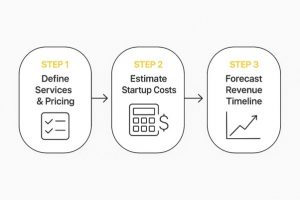
Defining what you offer will point you straight to the smartest equipment purchases.
Smart Investments for a New Business
When you’re starting out, every dollar counts. You need to focus on gear that gives you the best bang for your buck. This means choosing equipment that is reliable, versatile, and helps you finish jobs faster.
The goal is to build a core kit that can handle 80% of the work you’ll get in the early days. You don’t need every tool under the sun on day one. Start with the essentials that will make you money right away.
The Game Changer: A Mini Skid Steer
For a new business, versatility is everything. You need one machine that can do a lot of different jobs. This is where a stand on mini skid steer, like the Mechbadger, becomes your most valuable player. It’s the Swiss Army knife for any serious landscaper.
One day you might be digging trenches for irrigation, the next you’re moving a pallet of pavers, and the day after, you’re levelling a site for a new shed slab. With the right attachments—like a 4-in-1 bucket, auger, or trencher—a single machine does it all.
- Trenching: Quickly dig clean trenches for pipes, cables, or garden edging.
- Moving Materials: Use a bucket to shift soil, gravel, or mulch, saving your back and hours of hard yakka.
- Levelling and Grading: Prepare a perfect base for turf, paths, or small slabs.
- Drilling Holes: An auger attachment makes short work of post holes for fences and decks.
This ability to handle multiple jobs with one machine means you can say “yes” to more types of work, boosting your earning potential right from the start.
Building on a Solid Foundation with Compaction Gear
While a mini skid steer handles the heavy lifting, professional hardscaping—like paths, patios, and driveways—needs a perfect base. This is where quality compaction equipment is non-negotiable. If the ground isn’t properly compacted, the paving you just laid will sink and shift, leading to angry clients and having to do the job again for free.
Reliable gear like Batmatic plate compactors is crucial here. A forward plate compactor is your go-to for creating a solid, level surface for paving jobs. For tighter spots, like in trenches or around footings, a tamping rammer (what a lot of guys call a “jumping jack”) is the tool you need. It delivers focused compaction to make sure every corner of your base is rock solid.
Having a dependable plate compactor isn’t just about doing the job right; it’s about looking like a pro. When a client sees you using proper gear to build a solid foundation, it builds their trust and reinforces the quality of your work.
Investing in these machines means you can confidently build hardscapes that last. This is a profitable specialty that sets you apart from the basic “mow and blow” crowd.
Starter Kit vs. Expansion Gear
It’s easy to get carried away buying gear. The key is to start with what makes you money, then reinvest your profits into equipment that lets you take on bigger or more specialised jobs. Here’s a practical way to look at it.
| Equipment Category | Starter Kit Essentials (Day 1) | Expansion Gear (Year 1-2) |
| Earthmoving | Stand on Mini Skid Steer (e.g., Mechbadger) | Tracked Site Dumper, Mini Excavator |
| Compaction | Forward Plate Compactor, Tamping Rammer | Reversible Plate Compactor, Tracked Mini Cement Mixer |
| Landscaping Tools | Quality Shovels, Rakes, Wheelbarrow | Concrete Cutter, Laser Level |
| Power Tools | String Trimmer, Leaf Blower, Hedge Trimmer | Chainsaw, Portable Air Compressor, Demolition Hammer |
| Transport | Ute with a heavy-duty trailer | Small tipper truck |
This approach keeps your initial costs down while setting you up for smart growth. To understand more about how modern machinery is changing the game for businesses like yours, you can explore the new era of machinery for Australia and see what’s possible.
Starting with a solid, dependable core of equipment is a key step in building a landscaping business designed for profit.
Finding Your Niche in the Australian Market
 Starting a landscaping business means jumping into a crowded field. It’s tempting to be the “do-it-all” guy, but that’s a quick way to burn out and not make much money. The smartest move is to carve out your own space. It’s about finding that sweet spot where your skills, your gear, and what people actually want all line up.
You might have the right equipment, like a Mechbadger mini loader, but you need to aim it at the right jobs. Trying to offer lawn mowing, paving, retaining walls, and commercial maintenance all at once will stretch you too thin. Instead, think smart. What are clients in your local area actually willing to pay good money for? That’s where you’ll build a solid name and a healthy bank account.
Why Specialising Makes You More Money
When you specialise, you stop being just another landscaper and become the go-to expert. You become the “retaining wall bloke” or the “paving and patio pro.” This focus has real benefits that boost your bottom line.
- Higher Profit Margins: Experts charge more. Clients will pay a premium for someone who knows their stuff and has a track record of doing jobs just like theirs.
- Greater Efficiency: When you do the same kind of work over and over, you get bloody good—and fast—at it. You’ll know exactly how much material to order and how long the job will take. For example, you’ll get so quick with your Batmatic compactor and mini loader that you can prep and lay a patio in half the time of a generalist.
- Simpler Marketing: It’s much easier to market your business when your message is clear. “We build the best decks and patios in the area” is more powerful than “We do all kinds of landscaping.”
- Smarter Equipment Use: Specialising means your key gear, like a Machtig mini loader or that plate compactor, gets used all the time for the exact tasks they were built for. This is how you get the best return on your investment.
Focusing on a niche doesn’t mean you have to turn down every other job. It’s about building your main reputation and marketing around a service you can dominate. You’ll find other jobs often come to you anyway through word-of-mouth.
Scoping Out Your Local Market
So, how do you find the right niche? Start by taking a good, hard look at your local area. Don’t just guess what people want; find out for sure.
Check out the competition. See what other local landscapers are advertising. If everyone is just doing basic lawn care, you might see a huge gap in the market for quality hardscaping. This is where your investment in a mini skid steer and compaction gear really pays off.
It’s also worth looking at the bigger picture. In Australia, the number of landscaping businesses has shrunk by about -2.8% a year over the last five years. That might sound bad, but it’s actually a huge opportunity for serious, professional operators. As the less professional outfits disappear, you can stand out and grab their customers.
High-Value Niches to Consider
Ready to get specific? Here are a couple of profitable niches that are a perfect fit for a new business, especially if you’re set up with a mini loader and compaction gear.
Hardscaping and Paving Specialist
This is a classic for a reason: it’s profitable and always in demand. Homeowners are always looking to add value with new patios, driveways, and garden paths.
- What it involves: Ground prep, laying pavers or stone, and building small retaining walls.
- Why it’s a great niche: It needs special skills and equipment, like plate compactors and concrete cutters, that most DIY-ers and basic gardeners don’t own. This means less competition and you can charge more. A stand on skid steer makes the excavation and moving materials incredibly efficient, turning a three-day job into a one-day job.
Small-Scale Earthworks and Site Prep
Many contractors and even keen DIY-ers need someone for the initial grunt work. They need a site cleared, levelled, or prepped for another trade.
- What it involves: Clearing sites, levelling for turf or sheds, digging trenches for plumbers, or preparing a base for concreters.
- Why it’s a great niche: Your mini skid steer and attachments are the hero here. You can become the go-to guy for jobs that are too big for a shovel but too small for a huge excavator. You can get in and out quickly, making good money without the long-term project management.
By zeroing in on a niche, you go from being just another landscaper to a valued specialist. This is the foundation for a business that doesn’t just survive, but actually thrives.
Pricing Your Work to Be Profitable
Quoting jobs can be one of the most stressful parts of starting a landscaping business. Go too high, and you lose the work. Quote too low, and you’re doing all the hard work for nothing. Getting this right is what separates a real business from a tough hobby that costs you money.
The secret isn’t to guess. It’s about knowing your numbers, inside and out, so you can build a quote that covers every cost, pays you a decent wage, and leaves a solid profit in your business account. This is how you build a sustainable business.
Calculating Your Real Hourly Rate
Before you can price any job, you need a baseline: your true hourly operating cost. This isn’t just the wage you want to pay yourself. It’s a figure that includes all your business overheads—the money you spend just to stay in business, whether you’re working or not.
Get a notepad and start listing your fixed annual costs.
- Insurance: Public liability, tool and equipment, vehicle.
- Vehicle Costs: Rego, maintenance, fuel, loan repayments.
- Tools & Equipment: Factor in maintenance for your Batmatic compactor and Mechbadger mini skid steer, plus fuel, repairs, and saving up to replace them.
- Admin & Software: Your phone bill, accounting software like Xero, and website hosting.
- Other Overheads: Workshop rent, accountant fees, marketing.
Add all those annual costs up. Now, figure out how many hours you can actually bill for in a year. Be realistic—don’t just calculate 40 hours a week for 52 weeks. Account for public holidays, sick days, and time spent quoting. A good starting point is around 1,500 billable hours a year.
Simple Maths: (Total Annual Overheads + Your Desired Annual Salary) ÷ Total Billable Hours = Your Base Hourly Rate. This is the absolute minimum you must charge per hour just to break even and pay yourself. Profit is added on top of this.
From Hourly Rate to Job Quote
Once you have your base rate, you can build proper quotes. A good quote isn’t just a number; it’s a breakdown of materials, labour, and a healthy profit margin to make sure your business grows.
Knowing the market also helps. The Australian landscaping market is big, around AUD 7.7 billion in 2024, but it might dip slightly to AUD 7.4 billion in 2025. This tells you to be competitive, but not to sell yourself short.
Real-World Quote Example: A Simple Paving Job
Let’s walk through a common job. A client wants a small 3m x 4m paved patio. Here’s how you’d break it down.
- Materials: Calculate everything needed, plus extra for waste.
- Pavers (12 sqm + 10% for cuts/breakages)
- Road base and paving sand
- Cement for edging
- Delivery fees
- Total Materials Cost + 20% Markup: Your markup covers your time chasing materials and adds a slice of profit.
- Labour: Estimate the hours for each stage.
- Excavation and site prep (with your Mechbadger): 4 hours
- Spreading and compacting base (with your Batmatic compactor): 3 hours
- Screeding sand and laying pavers: 6 hours
- Cutting and finishing edges (with a concrete cutter): 3 hours
- Total Labour: 16 hours x Your Base Hourly Rate.
- Equipment Use: Your machinery isn’t free to run. Add a line item for major equipment, as if you were hiring it to yourself.
- Mini Skid Steer Charge: $100
- Plate Compactor Charge: $50
- Profit Margin: This is how the business grows. After covering all costs and your wage, add profit. A healthy margin is usually between 15% and 30% on top of the combined cost of materials and labour.
By presenting a quote that details these things, you show the client you’re a pro who has thought through their project. You’re not just guessing; you’re showing value. This is how you start a landscaping business that’s built to last.
For a deeper dive into getting the most out of your tools, check out our pro’s guide to vibration plate compactors.
Alright, you’ve sorted the business side and your gear is ready. But even the best equipment, like a brand-new Mechbadger mini skid steer, won’t make you money sitting in the shed. Now it’s time to find people who will actually pay you.
When you’re starting out, forget complex, expensive marketing. Getting your first clients is about smart, simple actions that build your name.
Good marketing for a tradie isn’t about fancy talk. It’s about proving you’re reliable and do quality work. Your reputation is the most powerful tool you have, and it starts with your first job.
Get Found Where Your Customers Are Looking
When someone needs a landscaper, the first thing they do is pull out their phone. You have to be there when they search. The best ways to do this are simple and free.
- Google Business Profile: This is non-negotiable. It’s the new Yellow Pages. A Google Business Profile puts you on Google Maps, lets customers leave reviews, and shows your photos and contact info.
- A Simple Facebook Page: Use this as your live portfolio. Post good before-and-after photos of every job. Show off that perfect base you laid with your Batmatic compactor or the clean trench you dug with your mini loader. A photo of a great job sells better than any words.
My Two Cents: Always ask the client’s permission before you start taking photos. Get wide shots, close-ups on the details, and—most importantly—a “before” shot. Nothing sells your skills better than showing a huge transformation. This is pure gold online.
Build a Solid Referral Network
Believe it or not, your best jobs won’t come from a Google search. They’ll come from other tradies who see your work and trust you. Building these relationships is one of the smartest things you can do.
Start connecting with other local businesses who work with the same homeowners you’re targeting. Let them know what you do best, whether it’s hardscaping, site prep, or something else. A quick chat over a coffee or just introducing yourself on-site can lead to a lot of future work.
Here’s who you should get to know:
- Local Builders: They always need good landscapers for new builds and renos.
- Real Estate Agents: They need properties looking their best for sale, often at short notice.
- Other Tradies: Plumbers, electricians, and concreters are often on-site just before you are. A good word from them is invaluable.
This Is a Marathon, Not a Sprint
Building a successful business doesn’t happen overnight, but the future for landscaping in Australia looks good. The industry has ups and downs, but it’s set to grow. Projections show the market could grow at a rate of around 8.5% a year between 2025 and 2035.
This growth is driven by Aussies wanting to improve their homes and create better outdoor spaces. For a new business owner who puts in the hard yards now, this means a decade of opportunity.
At the end of the day, getting those first clients is about proving your value. Combine a professional online presence with real-world networking, and back it all up with top-notch work. That’s the formula for building a client list that sticks, and a business that’s built to last.
Your Top Questions Answered: Starting a Landscaping Business
 If you’re thinking about starting your own landscaping business, you’ve probably got a heap of questions. That’s a good sign. Let’s tackle some of the most common ones.
What’s the Biggest Mistake New Guys Make?
Without a doubt, the biggest mistake is undercharging. It’s a classic rookie error. You’re keen for work, so you quote low. But you forget the hidden costs: insurance, fuel, equipment maintenance for things like your mini loader and compactor, and your own wage.
You end up working flat out, exhausted, with nothing left in the bank to show for it. Before you quote your first job, you have to know your numbers.
When Should I Hire My First Employee?
Hiring your first person is a huge step. The right time to hire is when you’re consistently turning down good, profitable work because you physically can’t do it all yourself.
Don’t hire someone just because you’re feeling a bit busy. You need to hire when the numbers prove it’s the right move. Your schedule should be so packed that another person’s wage is easily covered by the extra jobs their help lets you take on. Think about starting them on a casual basis to test the waters first.
Ready to gear up with machinery that’s built for the tough jobs? MÄCHTIG Mobile Equipment delivers the powerful, reliable tools you need to build a profitable landscaping business. From versatile Mechbadger mini loaders to tough Batmatic compactors, we’ve got the gear that gets the work done.
Explore our full range of premium European machinery by visiting MÄCHTIG Mobile Equipment.